
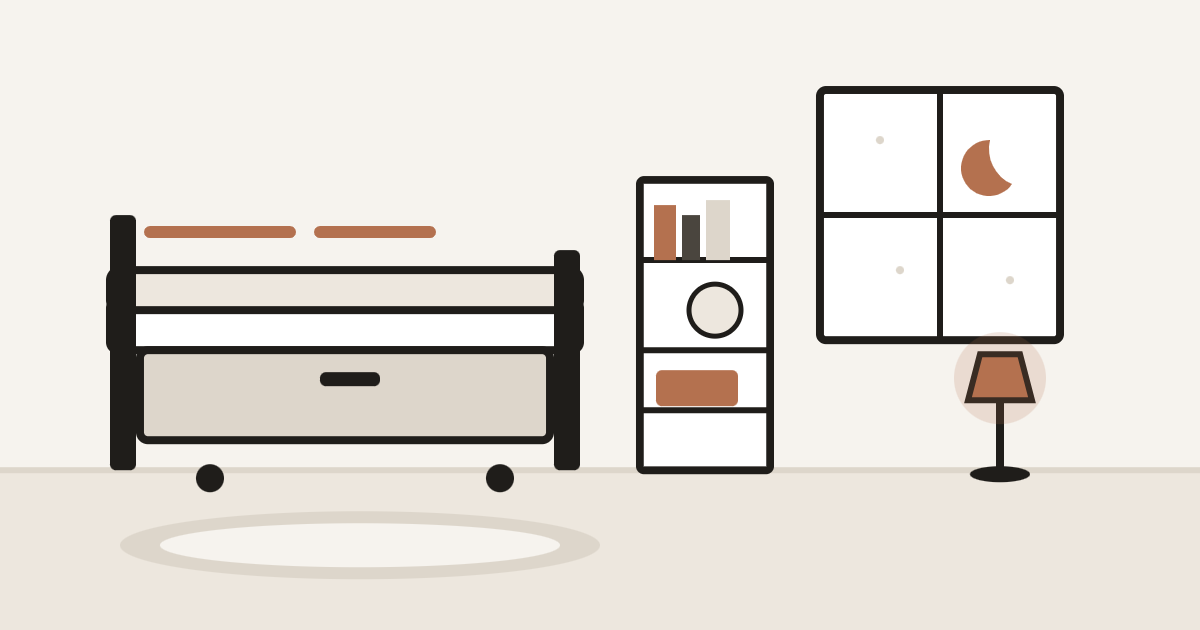
Nurseries in Tallinn are rarely spacious. Panel blocks in Mustamäe and Lasnamäe have compact rooms, old houses in Kalamaja and the Old Town come with unpredictable layouts, and new builds, in Noblessner or the Rotermann quarter for example, have small but regular rooms. One thing they share: children outgrow furniture faster than you can replace it. Here is how to place the essentials so you do not buy everything again in two years.
Measure and draw first
Take a tape measure and sketch the room to scale: window, door, radiator, sockets. Mark the floor space that must stay free, because that is where your child will play, not on the bed. If furniture eats the whole floor, the room feels smaller than it is. The rule is simple: floor for play first, everything else after. Measure the doorway and the stairwell too: a bed has to get into the building, not only the room.
A bed that grows with the child
For a toddler of one or two, a floor bed with low sides works well: your child climbs in and out alone, and you can lie down beside them. The rail comes off as they grow. Choose a bed with spare length: in our Beds & mattresses you will find models 140, 160 and 180 cm long, with or without a storage drawer under the mattress, and many come with a removable rail. Mattress size and rail height are covered in our guide How to choose a floor bed or a house bed. Bunk beds suit older children: according to the makers, the upper bunk is for children from six, the lower bed from three. In a narrow room they free the floor, but not before the right age.
Storage: low and open
In a small room, go vertical. Low open shelves, no taller than your child’s shoulder, let them fetch and put away a toy by themselves while the top stays for things that are not for little hands. In Shelves & bookcases, read each description: if the maker recommends fixing to the wall, do it. Clothes and bedding go in the drawer under the bed or in a chest; baskets for small things beat a wardrobe because a child tidies into them alone.
A learning tower is for the kitchen too
City kitchens are tight, and a child has little room in them. A learning tower lifts a toddler to counter height: they join in with cooking instead of standing at your feet. Height, age and stability are covered in our learning tower guide. A good tower folds or at least tucks against the wall so it does not block the way.
Zones and light
Divide the room mentally into three zones: sleep, play and storage. Put the sleep zone away from the door and radiator, the play zone near the window and light, and storage along a wall. A soft rug marks the play area and warms the floor; in panel blocks it also muffles sound. At night a warm, dim light helps: see our guide A night light for the nursery and Night lights & lamps.
Three common situations
Panel block. A small room with standard ceilings: choose a floor bed, open shelves and anything that folds. Old house or Old Town. Ceilings can be high and walls and corners crooked, so modular furniture works best; keep the upper bunk for children of six and over. New build. The room is regular but small: storage under the bed and on the wall frees the floor.
Finally, neither you nor your child needs to spend all day in one room. We collected warm places for weekends in our calendar of children’s events in Tallinn (in Estonian and Russian).
Frequently asked questions
From what age can a child sleep in a bunk bed?
According to the makers, the lower bed suits children from three and the upper bunk only from six. Do not put a younger child on the upper bunk.
Does a shelf need fixing to the wall?
Tall shelves are better fixed; makers usually say so plainly in the description. A child will not tip a low open unit, but check the instructions.
Which bed lasts longest?
One with spare length, a removable rail and room for a drawer: the same frame then serves from two or three years old until school.